

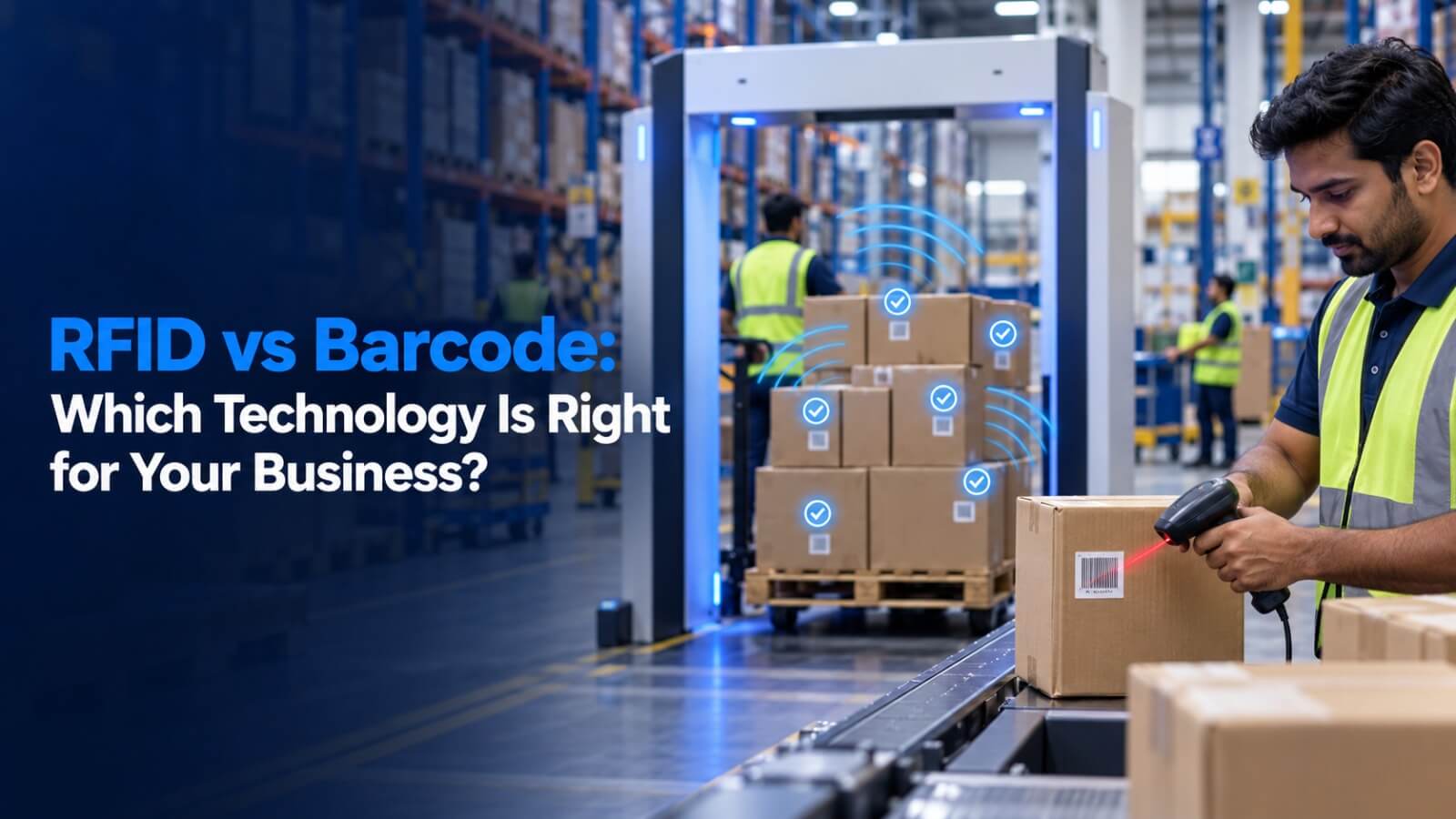
Businesses rely on accurate identification to track inventory, manage assets and maintain operational visibility. RFID and barcode systems both support these activities, but they work differently and serve different requirements.
What Is a Barcode System?
A barcode stores information in a printed visual pattern. A scanner must have a clear line of sight to read it. Barcodes are affordable, easy to print and suitable for applications where employees can scan items individually.
They are commonly used for:
- Product identification
- Billing and checkout
- Stock management
- Shipping labels
- Document tracking
What Is RFID?
RFID uses radio waves to identify tagged items. RFID tags communicate with compatible readers without requiring direct visibility. Depending on the selected technology and environment, multiple tags may be detected during a single reading operation.
RFID is commonly used for:
- Asset tracking
- Inventory automation
- Employee attendance
- Access control
- Warehouse operations
- Vehicle identification
- Event credentials
RFID vs Barcode
| Factor | Barcode | RFID |
|---|---|---|
| Reading method | Requires line of sight | Uses radio waves |
| Reading process | Usually one item at a time | Can detect multiple tags |
| Automation | Mostly manual scanning | Supports automated detection |
| Data capacity | Limited | Depends on the selected tag |
| Durability | Printed labels may be damaged | Multiple tag constructions available |
| Initial cost | Lower | Higher |
| Operational speed | Suitable for basic workflows | Suitable for faster workflows |
When Should You Choose Barcodes?
Barcode technology may be appropriate when:
- Items can be scanned individually
- The operating process is primarily manual
- Direct visibility is not a problem
- The initial budget is limited
- Large-scale automation is unnecessary
When Should You Choose RFID?
RFID may be more suitable when:
- Many items must be identified quickly
- Direct line-of-sight scanning is difficult
- Assets move through defined detection points
- Real-time or automated visibility is required
- Manual scanning creates delays or errors
- Information must connect with an ERP, HRMS or inventory platform
Why a Site Assessment Matters
RFID performance depends on factors including tag type, frequency, material, reader placement, antenna orientation and the surrounding environment. Metal, liquids, closely packed items and nearby equipment may affect reading performance.
A controlled pilot should therefore be completed before implementing RFID across a large or business-critical operation.
Conclusion
Barcode systems remain practical for simple and cost-sensitive identification requirements. RFID is better suited to operations that require automation, speed and reduced manual effort.
TS Informatics designs RFID systems around the actual operating environment. Our team evaluates the workflow, recommends suitable tags and readers, conducts testing and supports integration and deployment.